Built to live two months.
It became the whole portal.
SALT Lending launched out of our office. We designed the membership sale, shipped it fast, then designed the product it was supposed to grow into. What nobody ever went back and did was rebuild the thing underneath it.
The engagement ran from 2016 into 2018. Phil was fractional CTO through the launch into SALT’s own building and their own teams: product strategy, tech lead, the data spine pairing token intake with OTC purchasing, exchange listings, and the contracts between the two shops. Over a full year of it went into the platform itself.

Five founders,
no developers.
That was the starting condition, and it explains most of what happened after.
Not a design job.
Product and tech, with a seat at the table.
The drawings further down this page are the part that survived, not the part that mattered. Five founders with no developers needed somebody to hold the technical side of a company while it launched a token and then built a lending platform in a crowded field, and that is what the engagement was.
The technical seat, until they could fill it themselves.
Phil served as fractional CTO through the launch and into SALT having their own building and their own teams. Product strategy and tech lead alongside it.
Token intake paired with OTC purchasing.
Money arriving on one side, purchasing pairing against it on the other, and the two having to agree while the market moved underneath them. That is not a screen. It is a system somebody has to watch, and it was ours to manage.
A token that is not listed is a spreadsheet.
Managed as part of the same engagement, alongside our relationship and contracts with SALT, up to the point where SALT took development inside.
This section comes from Phil’s own account rather than from the project drive. The drive kept the wireframes and the QA notes and kept almost nothing of the product and technical work, which is why this page read like a design engagement for as long as it did.
Every hard part was in the wireframe
by 12 May 2017.
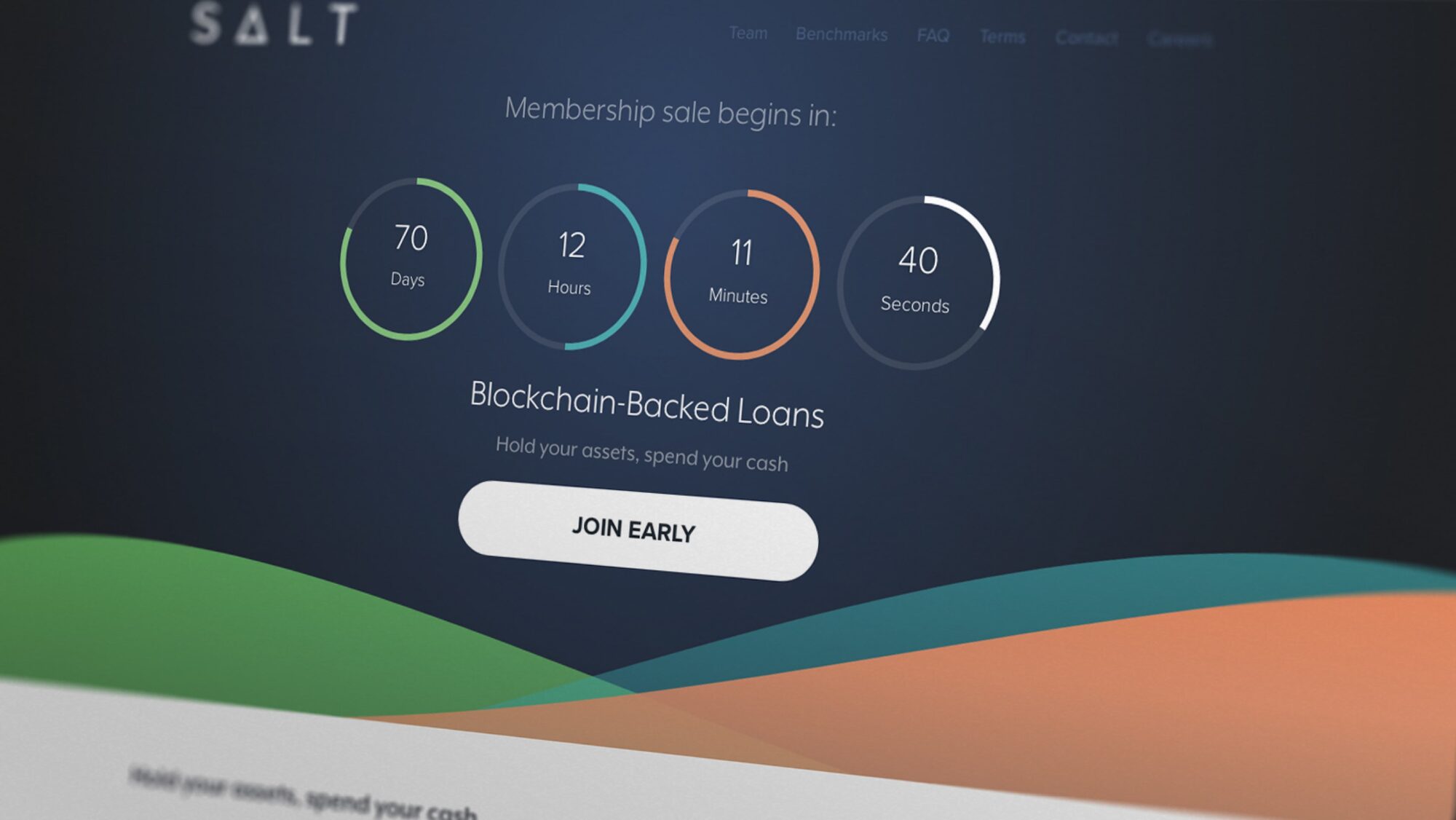
Initial Membership Sale. Not an ICO by name, and not a countdown with a wallet address taped to it. The intake, the custody, the two-factor and the loan math were all specified on paper before any of it existed. Six things the sale had to do:
The lending product’s actual math, inside the sale, before the platform that would run it existed.
Membership sold in bands. The ladder got its own designed screen.
Username and password, then two-factor with QR provisioning, then connect an Ethereum address. In that order, before an account could take a deposit.
The wireframe specified a Bitcoin deposit address generated for every account. Intake was per-account from the first drawing.
Because the people holding the collateral were not all holding the same thing, and telling them to go convert first is how you lose them.
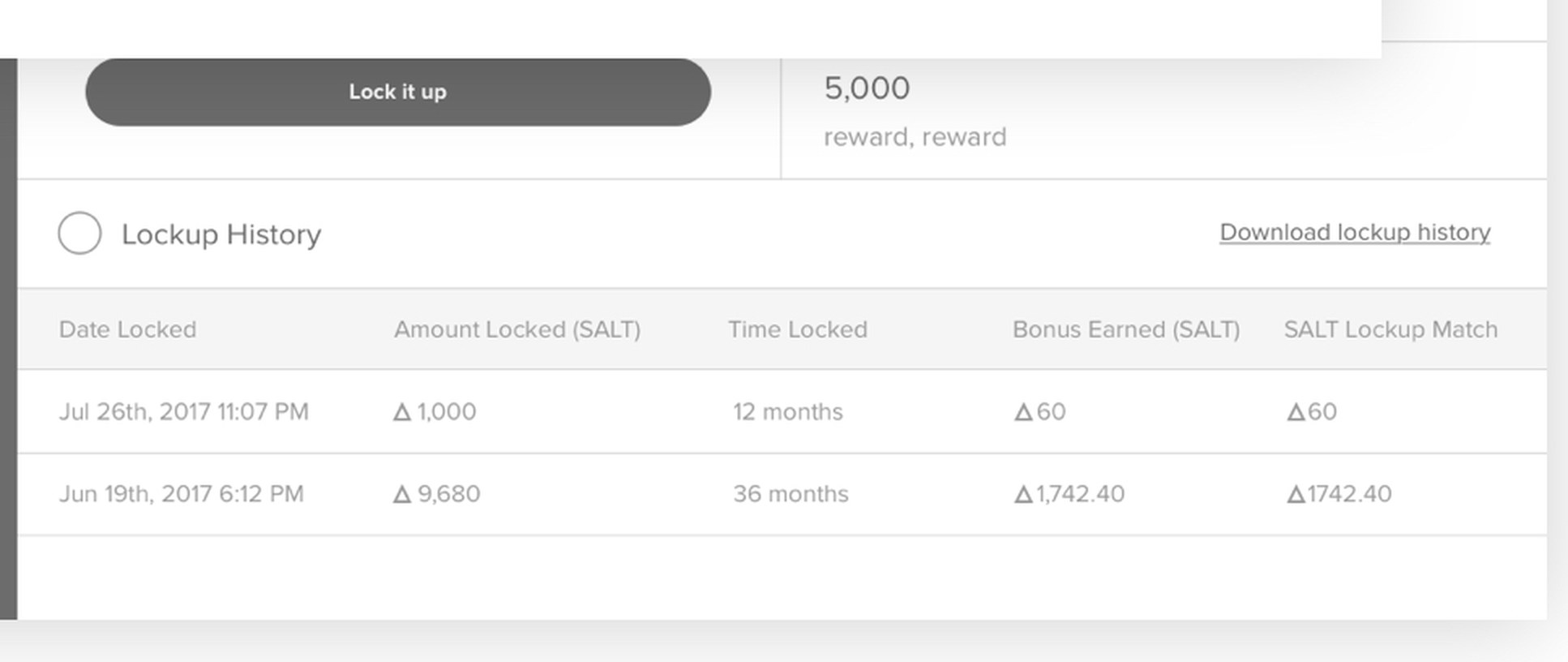
Buyers could see their position and their full history without emailing anyone.
Fifteen months after that wireframe, SALT’s own Chief Information Officer, interviewed 21 August 2018, described what it became in three flat sentences: we built the token platform, it “Started with BTC and then accepted ETH,” and “SALT was an ERC20 token.” Per-user BTC and ETH wallets generated for intake, BTC swept into Copay, ETH swept into Ledger. SALT later wrote its own blockchain monitoring service on top of that, cross-referencing several third-party services because no single one could be trusted alone.
Two withdraw flows.
Drawn in parallel, not argued about.
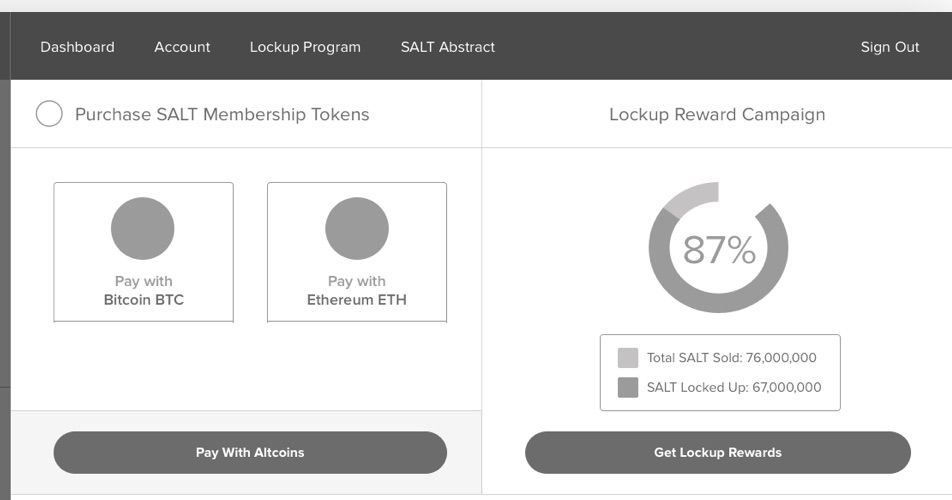
The Distribution and Membership set is organized by product surface rather than by screen: Membership, Lockup Program, Dashboard, Sidebar, and two withdraw processes that went into review side by side. Drawing both is cheaper than a meeting about which one is right.
Withdraw SALT, password and two-factor, confirm withdraw, view lockup. One confirmation gate before the transfer.
Withdraw SALT, confirm address, change ETH address, and a second email confirmation with its own link step. More friction on purpose, at the one step nobody gets to undo.
Whether you held a membership changed what the product was.
The Sidebar folder holds “Sidebar With Membership” and “Sidebar No Membership.” The Dashboard folder holds “Dash, Lockup Program No Membership.” So the state got drawn twice, everywhere it mattered.
What we wrote about ourselves
in July 2018.
An internal agenda called “SALT Improvements,” written 2018-07-30. It opens by naming what the thing was for: “This product was built quickly and with constantly changes requirements with the express purpose of holding an ICO.” Everything below follows from that sentence.
The server was then used to facilitate the membership and borrower portal, which it was not designed to do and consequently did not perform well.
SALT Improvements · internal agenda, 2018-07-30
The suggestion to refactor the code was made multiple times, but was not done so that resources could be dedicated to other projects/features/efforts.
SALT Improvements · internal agenda, 2018-07-30
It showed up three ways.
What we carry out of it: a system built to live one to two months will be asked to live forever, and the day it gets asked is the day it is too late to say no. Refactoring is a scheduling decision, and somebody has to own it before the thing underneath becomes load-bearing.
They took development inside.
That was the plan working.
SALT grew from five core founders to nearly a hundred employees in just over a year. When they had the headcount to run their own engineering, they did. We kept the sale and the infrastructure alive until the replacement was ready, eight months past its original deadline, and then it was shut off.
The part that was actually the work was the unglamorous one, and it was still technically advanced and demanding: the intake, the custody sweeps, the reconciliation, the design system. Someone has to keep the lights on while the future gets built.
The relationship outlasted the contract. Phil and Shawn Owen are still in touch. SALT is still around.
These guys understood the vision from day one. They built the product that created the category.
Shawn Owen · Co-Founder, Salt Lending
Green and blue to feel approachable. Salmon for the color of Himalayan sea salt.
The platform had to feel friendly to people who were about to hand over collateral, so green and blue carried that, and the salmon was picked for contrast against both and for the salt itself. Seven style guide versions in seven days got it there. Morning Green #85C884, Aqua Blue #40B2B5, Orange Sunset #E3936F. Mr Eaves XL for display, Proxima Nova for body. The logo never smaller than 40px on screen, the coin symbol never smaller than 25px.
2016 to 2018 · over one full year of continuous platform work · five core founders to nearly 100 employees in just over a year · replacement platform launched eight months past deadline
What the files hold, and what they do not.
This page is built almost entirely from our own files: a 2019 retrospective, an internal agenda titled “SALT Improvements” dated 2018-07-30, the 2018 lookbook and case notes, proposal files dated August 2016, and the dated wireframe and design sets. Those files say we spent over one full year on the platform, and they are also where the failures on this page come from: the retrospective and the internal agenda are quoted word for word. The agenda was written for internal use and was never meant to be read outside the shop; it is the most useful document in the folder, which is why it is here.
The outside sources. SALT’s own Chief Information Officer, interviewed 21 August 2018, is quoted verbatim. The Shawn Owen testimonial runs exactly as given.
What is vouched but not filed. The fractional CTO role is in the record; the exact date range is not. The data spine pairing token intake with OTC purchasing, and the exchange listings, are Phil’s own account: no file in the drive confirms either.
This page does not publish money figures. The two exchange-rate lines in the member dashboard artifact are removed for that reason, and the wireframe’s figures were placeholders in any case.
How AI would help
this now.
Everything above this line is in a file somebody can open. Nothing below it is. This is how we would run the same engagement today, with AI in the work, written as an opinion, because that is what it is.
This was a platform built at speed for a token sale, by five founders with no developers, and speed is precisely what AI sells. The membership surfaces, the lockup mechanics, the withdraw flows drawn in parallel, all of it drafts faster now. Better than that: the technical debt in our own July 2018 agenda is the kind a model is good at working through, and the P1 that sat undeployed is the kind of thing an agent watching the pipeline would have raised the same day.
It would not have told us the two-month server was about to become the business.
A server built to live two months became the whole portal, and nobody decided that. It happened while everyone was shipping. AI makes building faster, which makes that failure mode more likely, not less. Somebody has to be watching for the temporary thing that has quietly become permanent, and that is a person noticing, not a model completing.
Building in crypto now? See what we do for blockchain teams today